How to Choose the Best Cob Led Light for Your Needs?
Choosing the right Cob Led Light for your needs can be challenging. With numerous options available, making the best choice requires careful consideration. Cob Led Lights are known for their efficiency and brightness. However, not all products are created equal. Some may not deliver the performance you expect.
When selecting a Cob Led Light, think about where and how you will use it. Will it be indoors or outdoors? The environment can greatly influence your choice. Also, consider the color temperature and brightness levels. Different projects demand different lighting conditions.
It's also important to review product specifications and user feedback. Understanding real-world experiences can guide your decision-making process. Look for reliable brands with a history of quality. Even though you may face some uncertainty, each decision offers a chance for growth. In the end, the right Cob Led Light can make a significant difference in your space.

Understanding COB LED Technology and Its Advantages
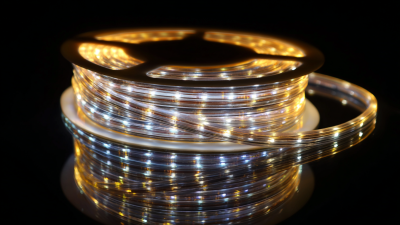
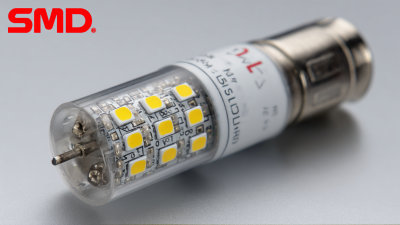
COB (Chip-On-Board) LED technology represents a significant advancement in lighting solutions. This innovation involves mounting multiple LED chips directly onto a substrate. This design maximizes light output and improves heat dissipation. As a result, COB LEDs offer exceptional brightness and efficiency. They produce a uniform light with fewer dark spots compared to traditional LEDs.
One key advantage of COB LEDs is their compact size. This allows for more design flexibility in various applications. However, users should be cautious about their heat management. Improper handling can lead to reduced lifespan. Another aspect is color consistency; while COB technology provides better uniformity, color variation can still occur among different batches. Therefore, selecting the right COB LED requires careful consideration and testing.
Understanding your specific needs is crucial. Determining the appropriate lumen output and color temperature will help in making informed decisions. Reflect on how different applications, such as residential, commercial, or industrial settings, might require various specifications. Engaging with experts in the field can also provide insights into optimizing your lighting choices.
Key Factors to Consider When Choosing COB LED Lights
When choosing COB LED lights, several key factors must be evaluated. The color temperature is crucial as it affects ambiance. Commonly, COB LEDs are available in a range of 2700K to 6500K. A warmer light creates a cozy environment, while cooler temperatures provide a more vibrant atmosphere. Industry research suggests that 80% of users prefer lights around 3000K for residential use, highlighting the importance of this feature.
Another vital consideration is the lumen output. Higher lumens indicate brighter light. According to a recent report, 1000 lumens is ideal for general spaces. However, excessive brightness can lead to glare and discomfort. Users often overlook this balance; thus, assessing the intended use can guide your selection. Beam angle also plays a role. A narrow beam is suitable for task lighting, while a wide beam is better for ambient lighting. Various angles, often ranging from 20° to 120°, cater to different needs. Users may find their requirements vary from projects to projects, demanding thoughtful evaluation.
Lastly, the quality of materials influences the durability and performance of COB LEDs. Opt for products with a high CRI (Color Rendering Index) score above 80 for true color reproduction. Reports show that lower-rated CRI can distort colors, leading to frustrating experiences. One must also reflect on energy efficiency, as it impacts long-term costs. Selecting COB lights with lower wattage but higher output can lead to significant savings. Balancing these factors ensures you make an informed choice that meets your specific lighting requirements.
How to Choose the Best Cob Led Light for Your Needs? - Key Factors to Consider When Choosing COB LED Lights
| Feature |
Importance |
Considerations |
Recommended Range |
| Color Temperature |
High |
Warm vs. Cool light preferences |
2700K - 6500K |
| Lumens Output |
High |
Brightness needs based on space |
300 - 2000+ lumens |
| Beam Angle |
Medium |
Focus of light needed |
60° - 120° |
| Lifespan |
High |
Replacement frequency |
25,000 - 50,000 hours |
| Wattage |
Medium |
Energy efficiency calculation |
5W - 50W |
| Dimming Capability |
Low to Medium |
Flexibility in lighting |
Compatible with dimmers |
Determining the Appropriate Brightness and Color Temperature
When choosing a cob LED light, brightness and color temperature are crucial factors that impact your space's mood and functionality. Brightness is measured in lumens. A higher lumen count means more light output. For a cozy atmosphere, consider lower brightness levels. For workspaces, brighter lights help with focus.
Color temperature, measured in Kelvin, dictates the light's warmth. Lower Kelvin values produce a warm glow, ideal for relaxation. Warmer light enhances comfort in living areas. Higher Kelvin values create a cooler, more energizing light suitable for task-oriented spaces.
Tips: Test lights in your environment before buying. The same wattage may look different in diverse settings. Consider dimmable options for versatility. Pay attention to how you feel in different lighting. Your comfort is essential. Often, experimenting with various setups can yield surprising results. Don't settle for the first choice. Reflect on lighting’s role in your daily life to make an informed decision.
Evaluating the Build Quality and Energy Efficiency of COB LEDs
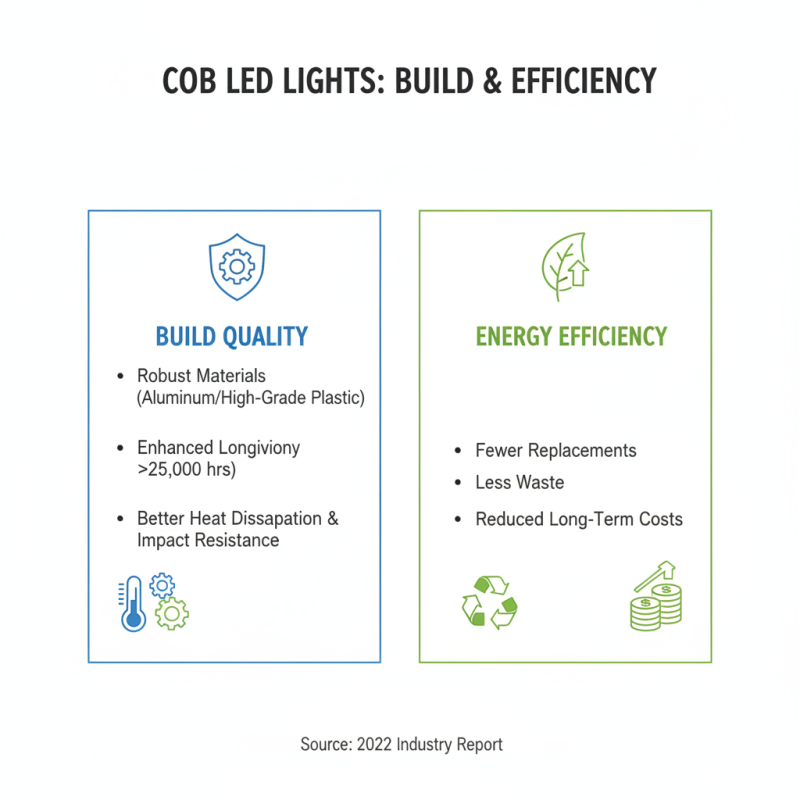
When choosing COB LED lights, it's crucial to evaluate both build quality and energy efficiency. High-quality COB LEDs often feature robust materials that enhance longevity and performance. According to a 2022 industry report, durable construction can significantly extend the life of LED products, with many lasting over 25,000 hours. This means fewer replacements and less waste over time. Users should look for lights with aluminum or high-grade plastic housings, as these materials offer better heat dissipation and impact resistance.
Energy efficiency is another vital aspect. The U.S. Department of Energy states that LED lights consume approximately 75% less energy than incandescent bulbs, which is a compelling statistic for environmentally-conscious consumers. Experts recommend considering the lumen output per watt. High-efficiency COB LEDs typically provide about 80-100 lumens per watt. This metric can help assess which products offer better performance for your energy costs.
However, even the most efficient lights have limitations. Some users report variance in color temperature, which can affect ambiance. Others find that initial costs may be higher, leading to hesitation. It’s important to weigh these factors against long-term savings. Reliable reviews and industry comparisons can offer insights into the best options for specific needs.
Comparing Brands and Pricing for Best Value in COB LED Lights
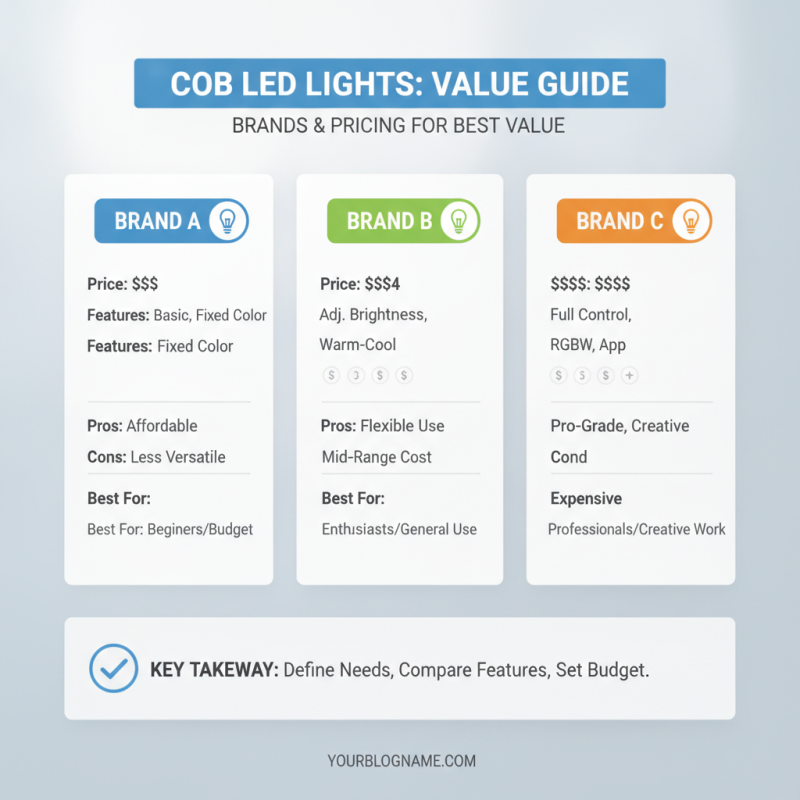
When selecting the best COB LED light, comparing brands and pricing is essential. Various brands offer different features, which can significantly impact your experience. For example, some lights provide adjustable brightness or color temperatures. Consider what matters most to you.
Tips: Look for user reviews. These often highlight strengths and weaknesses. Real feedback can guide your choice. Check for warranty options, too. A reliable warranty can protect your investment.
Prices can vary widely among brands. While it's tempting to go for cheaper options, durability and performance matter. An inexpensive light today may cost more in the long run. Aim for a balance of price and quality to ensure you get the best value for your needs.
Remember that lighting can affect mood and productivity. A well-chosen COB LED light can improve your workspace or living environment. Think about the ambiance you want to create. Small details make a big difference in your overall satisfaction with the product.