Energy-Efficient Lighting is now a practical purchasing priority, not just a sustainability slogan. The U.S. Department of Energy reports that LED products use at least 75% less energy and can last up to 25 times longer than incandescent lighting. Those figures provide a useful benchmark, but they do not guarantee equal performance across suppliers or products.
China has a broad lighting supply base, from component makers to export-focused manufacturers. For buyers, the challenge is separating measurable performance from polished catalog claims. This guide explores leading Chinese suppliers through details that matter on the ground: tested efficacy, color consistency, driver quality, warranty terms, production capacity, and after-sales support. A bright showroom sample is not enough. Ask for product-level test reports and confirm that quoted specifications apply to the exact model being purchased.
The International Energy Agency’s Energy Efficiency 2023 report highlights the wider importance of efficiency improvements, while product-level evidence remains essential for choosing a lighting partner. Supplier rankings can also shift with project needs, order size, and target market. Some comparisons will be imperfect; public data is uneven, and factory claims may need independent verification. That caveat matters. The following overview is intended to help readers compare suppliers carefully, identify useful questions, and shortlist partners whose technical evidence matches their project requirements.
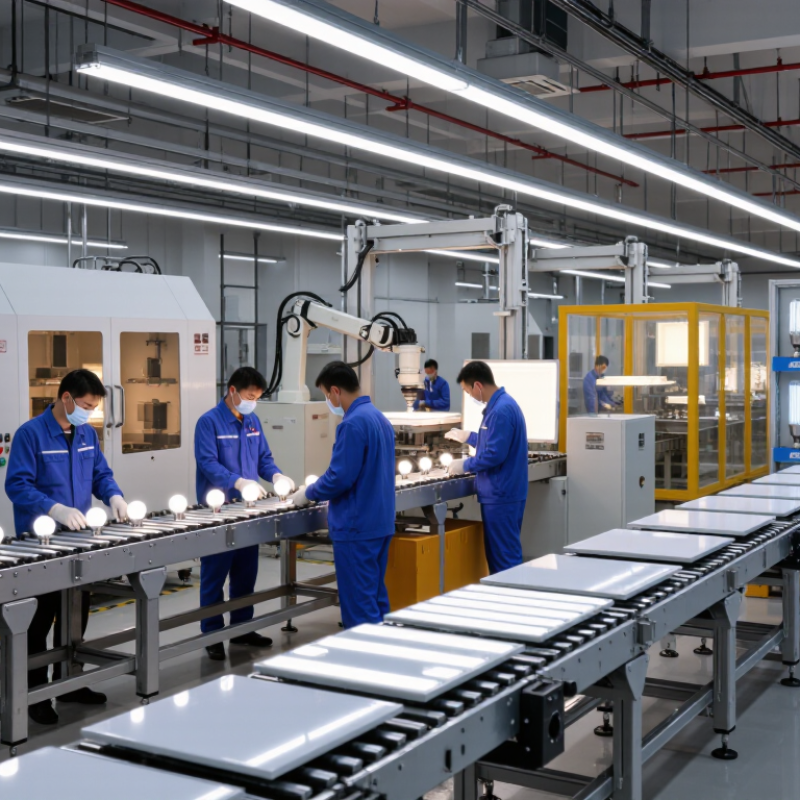
China’s lighting supplier landscape includes OEM, ODM, and brand manufacturers. OEM suppliers build products to a buyer’s specifications, such as a 4000K LED panel with a specific driver. This model suits businesses with established designs and clear quality requirements. ODM suppliers offer existing designs that can be adapted, often with changes to housing, packaging, or controls. Brand manufacturers sell under their own names, though some also provide private-label production.
These categories can overlap. A factory may develop its own fixtures and also manufacture to customer drawings. Ask who controls the design, testing, and final inspection. For energy-efficient lighting, compare measured power use, light output, color consistency, and thermal performance. Request current test reports and a sample from the same production line. A bright sample is not enough. Driver quality and heat management can affect performance over time, and a polished catalog may not reveal those details. Supplier descriptions can be confusing, so verify the actual production process.
Tips: Send the same specification to each supplier. Check the driver label, fixture temperature after extended operation, and consistency across several units. Clarify packaging, lead times, and how defects are handled. Small details matter. A lower quoted price may bring trade-offs worth questioning.
Supplier types and evaluation criteria below describe the market generally; they are not rankings or claims about individual companies. Verify certificates and performance data for the exact product model.
| Supplier type | Typical role | Energy-efficiency information to compare | Useful standards and evidence | Best suited for | Key checks |
|---|---|---|---|---|---|
| OEM manufacturer | Produces lighting products to a buyer’s specifications, which may include the buyer’s label or packaging. | Compare system efficacy in lumens per watt (lm/W) for the complete fixture, at stated input power and operating conditions. Check dimming compatibility and standby power where relevant. | Request model-specific photometric and electrical test reports. IES LM-79 covers measurements of solid-state lighting products; IEC 60598-1 covers general luminaire safety requirements. | Buyers with established specifications, volume requirements, or private-label needs. | Confirm that samples, production units, labels, and test reports refer to the same model and configuration. |
| ODM manufacturer | Develops or adapts product designs for buyers; the available design and customization scope varies by supplier. | Assess complete-fixture lm/W alongside light distribution, color consistency, thermal design, and available control options. | For LED luminaires, IEC 62722-2-1 addresses performance requirements. IES LM-80 data concerns LED packages, modules, or arrays; it is not a substitute for whole-luminaire testing. | Projects needing product adaptation, custom optics, or application-specific designs. | Define ownership of tooling and design files, change-control procedures, and approval requirements for component substitutions. |
| Brand manufacturer | Markets products under its own brand and may use in-house production, contract manufacturing, or a combination. | Compare published product specifications, warranty terms, replacement availability, and energy-performance data for the exact model. | Check applicable market certifications and test reports. IES TM-21 provides a method for projecting long-term lumen maintenance from LM-80 data; it is not a warranty or a direct measurement of fixture lifetime. | Buyers prioritizing established product ranges, documentation, and after-sales channels. | Verify the certificate holder, product scope, model number, and destination-market requirements. |
| Product efficacy | A comparison measure calculated as delivered luminous flux divided by electrical input power. | Use complete-product lm/W, not the LED chip’s efficacy alone. Compare products with equivalent application, light output, color quality, and test conditions. | Ask for a dated test report stating the tested configuration, input power, luminous flux, and measurement conditions. | Shortlisting products for a defined lighting task. | Do not compare headline lm/W figures unless the measurement basis and product configuration are comparable. |
| Lifetime and lumen maintenance | Describes how light output changes over time; the driver, thermal management, and operating conditions also affect product reliability. | Review LM-80 data for the relevant LED source and any TM-21 projection, then check the luminaire’s stated operating limits and warranty separately. | IES LM-80 and IES TM-21 provide relevant source-level measurement and projection methods. | Long operating-hour applications where maintenance access or replacement costs matter. | Treat projected lumen maintenance, rated life, and warranty as different claims with different evidence. |
| Safety and market compliance | Demonstrates whether a product has been assessed against requirements relevant to its design and destination market. | Compliance is not itself an energy-efficiency rating. Check efficiency separately using product-specific performance data and applicable local requirements. | Depending on the product and market, relevant references can include IEC 60598 for luminaires, IEC 62471 for photobiological safety, and RoHS substance restrictions. Applicability varies by product and jurisdiction. | Any buyer importing or installing products in a regulated market. | Confirm current rules for the destination market; a general certificate or declaration may not cover every model or requirement. |
China’s energy-efficient lighting suppliers commonly cover LED lamps, panels, high-bays, and streetlights. These products serve different spaces, so compare specifications within each category rather than relying on one efficiency figure. For LED lamps, check lumen output, wattage, color temperature, and dimming compatibility. A lamp rated at 4,000 K may look noticeably cooler than one at 3,000 K. Small detail, big difference.
Panels need even light distribution, suitable glare control, and reliable driver information, especially in offices with long operating hours. For high-bays, review mounting height, beam angle, and thermal management; a powerful fixture can still leave dark patches if its optics are poorly matched to the ceiling. Streetlights require careful attention to roadway optics, ingress protection, and documented photometric data. Ask suppliers for test reports, product samples, and warranty terms. A neat datasheet is useful, but it cannot show how a fixture performs in your actual room or street.
When comparing suppliers, check whether stated efficacy is measured for the complete fixture, not just the LED chip. Also ask about flicker, replacement parts, and consistency between sample units and production batches. These details are sometimes missing from sales materials. I would still verify them before placing a large order.
Indicative luminous-efficacy ranges for common LED product categories (lumens per watt).
The ranges are typical product-level benchmarks, not rankings of suppliers. Actual efficacy varies by model, power, optics, and operating conditions.
The U.S. Department of Energy says LEDs use at least 75% less energy than incandescent lighting. This comparison assumes similar light output, so check lumens rather than comparing wattage alone. A lower-wattage lamp may still feel dim if its lumen output is insufficient. Small differences matter.
When comparing lighting suppliers in China, request product data showing lumens per watt, color temperature, and dimming performance. Ask whether test results cover the exact model you plan to buy. Check how the fixture handles heat: a crowded ceiling fitting can trap warmth and affect performance over time. Requesting a sample for a real-space trial can reveal glare, uneven light, or color shifts that a specification sheet misses.
The energy benchmark is useful, but it is not a guarantee for every room or installation. A well-rated LED can disappoint when paired with an unsuitable dimmer or poor controls. I would not choose on efficiency figures alone; they need context. Compare measured output, expected operating hours, and warranty terms, then estimate energy use for your actual schedule. Even a careful estimate has limits.
Top Energy Efficient Lighting Suppliers in China?
A supplier’s efficiency claim needs evidence, not just a bright sample on a showroom table. Ask for LM-80 data covering the actual LED package or module used. LM-80 records lumen maintenance under stated test conditions; it does not test the whole luminaire. TM-21 calculations use LM-80 data to estimate long-term lumen maintenance. Check the projection period, assumptions, and source data. A confident number without its basis is not enough.
Tips: Match every report to the exact product code, LED component, and operating current. Confirm test dates, laboratory details, ambient temperature, and measured results. Small details matter.
Request relevant IEC test reports for the complete fixture, including the applicable safety and performance standards. Compare the report’s model number and configuration with the quotation; a similar-looking product may use different drivers or optics. Ask whether testing was performed by an independent laboratory, and verify the report directly when possible. I have seen paperwork that looked complete but described an earlier product revision. That gap matters. Suppliers should explain any mismatch clearly and provide updated evidence before production approval.
When comparing energy-efficient lighting suppliers in China, ask for certificates tied to the exact product and production site. Check applicable electrical safety and electromagnetic compatibility documents, plus LM-80 data for LED packages and TM-21 lifetime projections where available. A certificate logo alone is weak evidence. Verify report numbers, test dates, and model codes with the issuing laboratory. The U.S. Department of Energy reports that LEDs use at least 75% less energy and can last up to 25 times longer than incandescent lighting. That advantage depends on the complete fixture, including its driver and thermal design.
Factory capacity needs evidence beyond a stated monthly output. Review production-line counts, recent utilization, aging-test procedures, and quality records for comparable orders. Ask how the supplier handles peak-season demand and component shortages. A factory tour helps, but one visit cannot prove consistent performance. Request a sample run and inspect packaging, wiring, and light uniformity. Small details count. Confirm the minimum order quantity, too, and ask whether it changes with customization, packaging, or certification requirements.
Compare lifecycle cost, not just unit price. Estimate energy use from wattage, operating hours, and your local electricity tariff; then add installation, likely driver replacement, maintenance labor, and warranty coverage. The DOE savings figures offer a useful benchmark, not a guarantee for every installation. Put the assumptions in writing. I would also leave room for uncertainty: real service life can vary with heat, switching frequency, and operating conditions. A low MOQ may reduce inventory risk, but it can raise per-unit costs.