What Are the Top LED Bathroom Lights for Global Buyers?
Choosing the right Led Bathroom Lights requires more than comparing brightness and price. Global buyers must examine safety, visual comfort, energy use, and long-term reliability. A bathroom combines water, steam, mirrors, and reflective surfaces. Poorly selected lighting can create glare across the mirror or leave dark areas beside the face.
Dr. Mariana Figueiro, a leading lighting researcher, has said, “Light is the most powerful synchronizer of the human circadian system.” This insight matters in bathrooms used early in the morning and late at night. Warm, dimmable light can support a calmer evening routine, while brighter neutral light may improve shaving or makeup application. Yet, comfort depends on design, not only color temperature.
The top Led Bathroom Lights for global buyers should offer suitable moisture protection, high color rendering, stable performance, and clear installation instructions. Look for an appropriate IP rating, especially near showers and sinks. A CRI of 90 or higher can reveal natural skin tones more accurately. Adjustable color temperatures are useful, but not essential for every home.
Voltage compatibility deserves careful attention. A product made for one market may not suit another without the correct driver. Buyers should request test reports, warranty terms, material details, and replacement support. Certifications can help, but they should be verified rather than trusted blindly.
Small details matter. A sealed aluminum body, a soft diffuser, and a flicker-free driver can change daily comfort. Still, no fixture is perfect. Some products promise waterproof performance but provide vague documentation. That weakness should prompt further questions before purchase. The best choice balances safety, aesthetics, practical installation, and dependable supplier evidence.
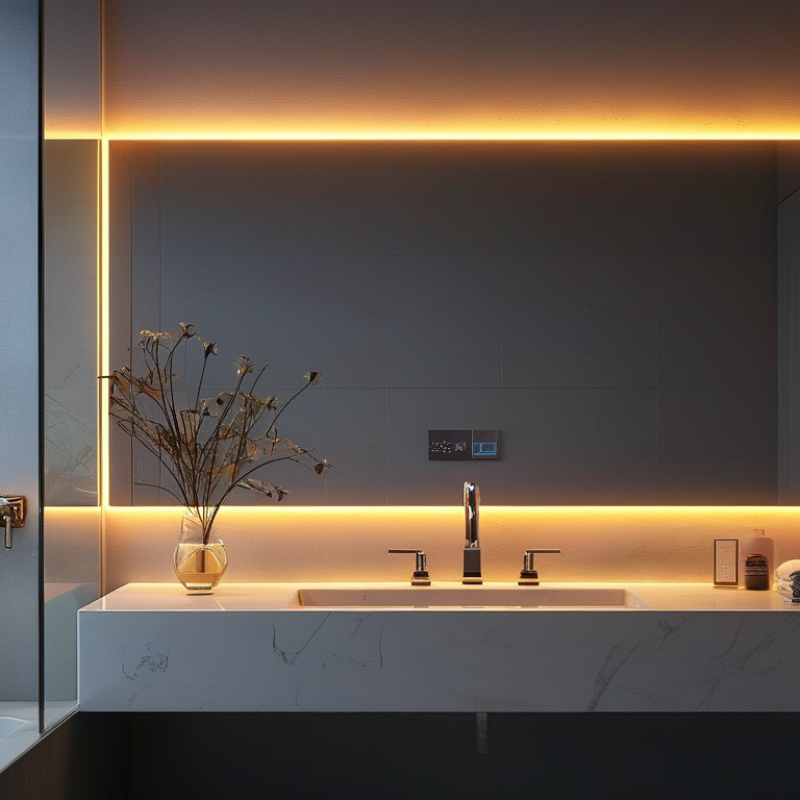
Top LED Bathroom Formats: Vanity, Mirror, Ceiling, and Recessed Lights
For global buyers, LED bathroom lighting works best when the format matches the task. Vanity lights should sit beside or above the basin, reducing shadows under the eyes. Choose diffused lenses, high color rendering, and a color temperature around 3000K to 4000K. A narrow fixture may look elegant but leave dark corners. Measure the mirror before ordering.
Mirror lights combine reflection and illumination in one surface. Front-lit mirrors provide clearer facial lighting, while edge-lit designs create a softer, decorative glow. Check the light output, switch type, demister function, and replacement access. Some mirrors appear bright in product photos but feel weak in a tiled bathroom. That detail deserves more attention.
Ceiling lights provide general illumination, especially in compact bathrooms. Use sealed, moisture-resistant fittings suitable for the installation zone and local electrical requirements. Recessed lights create a clean ceiling line, but poor placement can produce harsh shadows over the sink. Spacing them around the user, rather than directly behind the head, often improves comfort. A qualified electrician should confirm wiring and protection requirements. Do not rely on appearance alone. Surface-mounted ceiling lights are easier to service, while recessed models may need accurate cutting and extra ceiling depth. In my experience, the most reliable choice is rarely the brightest one; balanced glare control, color accuracy, and practical maintenance matter more.
Top LED Bathroom Light Formats for Global Buyers
The chart compares representative midpoints of commonly published residential LED bathroom-light specifications. Ceiling lights generally provide the highest overall lumen output, while recessed lights offer focused illumination for smaller or layered lighting plans. Vanity and mirror lights are commonly selected for face-level lighting around sinks and grooming areas.
Efficiency and Service Life: ENERGY STAR Reports 75% Lower Energy Use
For global buyers, bathroom lighting must handle moisture, frequent switching, and long daily use.
ENERGY STAR reports that LED lighting can use about 75% less energy than incandescent lighting. That difference appears clearly in utility bills.
A 10-watt LED can replace a 40-watt incandescent lamp with similar brightness.
Lower heat output also makes small bathrooms feel more comfortable. However, savings depend on correct installation, ventilation, and actual usage patterns.
Service life is another practical advantage.
ENERGY STAR states that qualified LEDs can last up to 25 times longer than incandescent bulbs.
Fewer replacements reduce ladder work, labor costs, and disposal needs. In a busy family bathroom, that reliability matters.
I have found that sealed fixtures perform better near showers, but not every “waterproof” claim deserves equal trust.
Buyers should check the IP rating, testing documents, and warranty terms.
Light quality still requires careful judgment.
Around 3000K creates a warm, natural appearance, while 4000K shows facial details more clearly.
Choose lumens rather than watts when comparing brightness. Check voltage compatibility before importing fixtures. A dimmer may also need LED-specific support.
I once selected a light that looked powerful online but felt weak beside a mirror.
Measurements helped more than attractive product photos. Look for verified safety certification and replaceable components when available.
Global Buying Checks: IEC 60598, CE/RoHS, UL/ETL, UKCA, and Warranty
For global buyers, the best LED bathroom light is not simply the brightest model. It should match local compliance rules, moisture conditions, and service expectations.
The International Energy Agency estimates that lighting uses about 15% of global electricity, so efficient LED selection matters beyond the bathroom.
IEC 60598 testing should cover electrical safety, insulation, heat, and luminaire construction.
For European shipments, request CE documentation and RoHS evidence for restricted substances. A CE mark alone is not a complete safety report. Ask for the declaration, test number, and product model. In North America, UL or ETL certification should match the exact light and installation method. For Great Britain, UKCA requirements may apply, although market rules can change. Check current government guidance before ordering.
IP ratings deserve close attention near showers and sinks.
A higher number is not automatically better if installation instructions are unclear. The U.S. Department of Energy’s solid-state lighting reports show that modern LEDs can exceed 100 lumens per watt, but real bathroom performance depends on optics and heat control.
I have seen efficient lights feel dim under frosted covers. That detail is easy to miss.
A practical warranty should state years, replacement procedure, labor limits, and operating conditions. Three years may sound acceptable, yet weak terms can create expensive delays.
Keep test files and invoices together. Mistakes still happen.