Choosing a Led Vanity Light for international projects involves more than comparing prices and appearance. A mirror may look elegant in a showroom, yet harsh shadows can appear during daily grooming. The right model should provide balanced illumination, reliable performance, and practical installation details.
Global buyers often compare color temperature, color rendering index, brightness, voltage, plug types, and dimming compatibility. A 3000K light can create a warm bathroom atmosphere, while 4000K may show makeup colors more naturally. Check the CRI carefully. A high CRI is useful, but published data should come from credible testing rather than attractive product claims. IP ratings, heat management, cable quality, and mounting hardware also deserve attention. Small details matter.
Supplier evaluation is equally important. Request samples, technical datasheets, warranty terms, compliance documents, and clear packaging specifications before placing a large order. Inspect the fixture, driver, finish, and included accessories. Test it beside a real mirror, not only under warehouse lighting. Ask how replacement parts are handled.
No checklist is perfect. A product may pass a sample review but reveal weak packaging during shipping. Even experienced buyers can overlook installation labor or local electrical requirements. These ten buying tips combine practical inspection habits, technical judgment, and supplier communication. They are designed to help buyers make safer, clearer decisions across different markets, project sizes, and customer expectations.
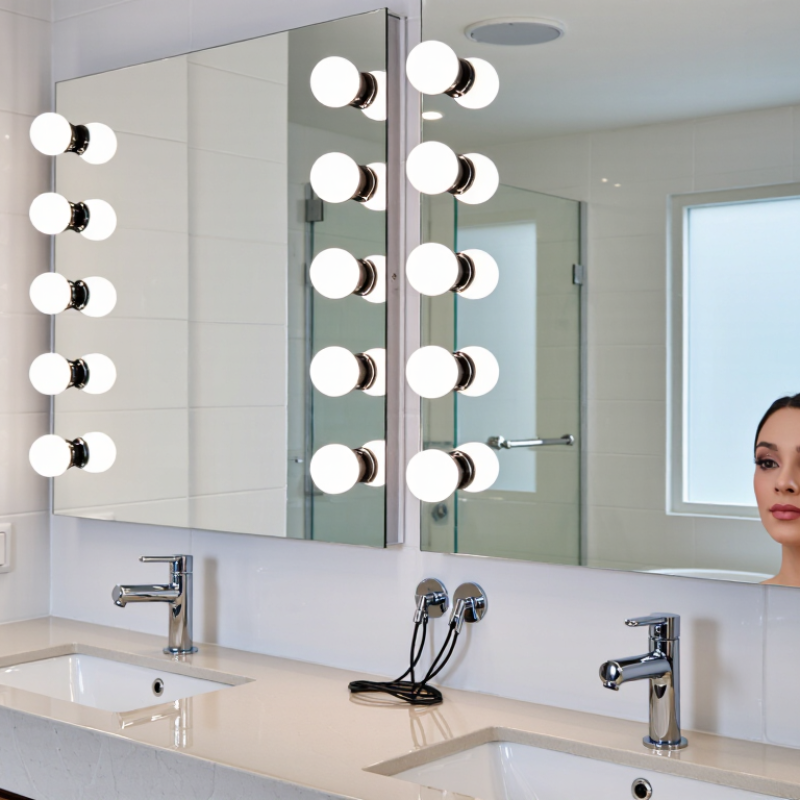
Before choosing a vanity light, define what the mirror area must do. Makeup requires even, shadow-reducing light from both sides or a wide front fixture. Shaving and skincare need clear facial detail, not dramatic decoration. A softer, dimmable fixture may suit a bedroom or guest bathroom. Keep it practical. Note who uses the space, how close they stand, and whether the light runs for minutes or hours. These details affect brightness, beam spread, heat, and control choice.
Match the fixture to its installation setting. A bathroom installation may face steam and splashes, so check the stated ingress protection rating and local electrical requirements. Do not assume a sealed appearance proves safety. Around a mirror, measure the wall width, mirror height, cabinet doors, and available junction box. Above-mirror mounting can create shadows under the brow. Side mounting usually gives more balanced facial light, but it needs enough wall clearance. In a salon or hotel, frequent switching makes thermal performance and service access more important.
Color quality deserves a real test. Look for strong color-rendering performance, especially when users match foundation or inspect skin. Neutral white light often feels accurate, but personal preference varies. Very cool light can feel harsh. Very warm light can distort colors. Check voltage compatibility, wiring method, dimmer compatibility, and mounting hardware before ordering internationally. A qualified electrician should confirm compliance with local rules. A plan can look right on paper and still feel wrong in use. Glare, reflections, and poor placement may ruin an expensive installation. Recheck the layout at standing eye level. Small changes matter.
When comparing LED vanity lights, start with light output, not appearance. Lumens show total brightness, while lux shows brightness on the face. A fixture may list 1,200 lumens but deliver less light after diffusion and installation.
For a bathroom mirror, compare tested lux at the typical standing distance, around 50–70 centimetres. Even lighting matters. Look for side illumination that reduces shadows beneath the eyes and chin.
Color temperature changes the room’s mood and the accuracy of daily grooming. Warm light near 2700–3000K feels comfortable but can make skin appear more yellow.
Neutral white around 3500–4000K often supports shaving, makeup, and skincare checks. Cooler light near 5000K looks crisp, yet may feel harsh in a small bathroom. Ask for the measured CCT, not only “natural white.” Specifications can vary between production batches.
Color rendering deserves equal attention. Choose a high CRI rating, preferably 90 or above, and check the R9 value for stronger red reproduction. This helps users judge blush, lipstick, and subtle skin tones more reliably.
However, CRI alone is not perfect. I have seen high-CRI samples with uneven brightness and distracting glare. Request test data, inspect a working unit, and compare two lights against a neutral white towel and a face in daylight. Small differences become obvious.
10 LED Vanity Light Buying Tips for Global Buyers
Size is the first practical check. Measure the mirror, wall width, and available clearance. A vanity light should not overpower the mirror or leave dark corners. For narrow bathrooms, a slim bar often fits better than multiple bulky shades. Mounting holes also matter. Wall boxes rarely align perfectly with imported fixtures. Check the backplate dimensions before ordering. Tip: Draw the fixture outline on the wall with masking tape. It reveals awkward proportions quickly.
Electrical compatibility deserves stricter attention. Confirm the rated voltage, frequency, lamp type, and dimmer requirements for the destination market. Never assume a plug adapter solves voltage differences. It does not. The U.S. Department of Energy reports that LED lighting uses at least 75% less energy and can last up to 25 times longer than incandescent lighting. That benefit depends on correct installation and heat control. Check whether the fixture includes a driver, and whether that driver supports the local input range. IEC 60598-1 is a useful reference for luminaire safety requirements. Local certification may still be required.
Tip: Ask for wiring diagrams, ingress protection details, and installation instructions before purchase. The IEA’s Energy Efficiency 2024 report describes efficient lighting as a mature energy-saving measure, but product quality still varies. I have seen attractive fixtures fail because the junction box was too shallow. That detail is easy to miss. Leave space for ventilation, especially above mirrors where steam collects. A perfect checklist is unlikely. Recheck measurements before payment.
| No. | Buying Dimension | What to Check | Typical Specification or Practical Guideline | Why It Matters | Buyer Action |
|---|---|---|---|---|---|
| 1 | Overall Size | Compare the light length or width with the vanity cabinet and mirror. | For a balanced appearance, the fixture is commonly selected at approximately 60%–100% of the mirror width. Measure the available wall space before ordering. | A fixture that is too long may look crowded; one that is too short may provide uneven visual coverage. | Record the mirror width, wall width, and clearance above the mirror. |
| 2 | Mounting Orientation | Confirm whether the product supports horizontal, vertical, or reversible installation. | Horizontal mounting is common above mirrors; vertical mounting can be used at one or both sides when the design and wiring allow it. | The mounting direction affects face illumination, appearance, and cable positioning. | Request installation diagrams and verify that the mounting bracket can be rotated if needed. |
| 3 | Mounting Surface and Box | Check wall material, junction-box position, bracket dimensions, and fixing-hole spacing. | The supplied hardware should match the installation surface. A suitable electrical box and secure fixing points are required for hardwired models. | Incorrect hole spacing or unsuitable anchors can cause instability and difficult installation. | Compare the technical drawing with the local junction box and use qualified installation support where required. |
| 4 | Electrical Compatibility | Verify rated input voltage, frequency, wiring method, and whether a driver or transformer is included. | Common household systems include approximately 100–127 V or 220–240 V AC at 50/60 Hz. A product marked for a wide input range, such as 100–240 V AC, may support multiple markets when certified accordingly. | Voltage mismatch can cause malfunction, overheating, or a safety hazard. | Match the product label to the destination market and have hardwired connections checked by a licensed electrician. |
| 5 | Light Output | Check total lumens rather than judging brightness only by wattage. | Small accent fixtures may provide around 500–1,000 lumens; larger vanity fixtures often provide about 1,000–2,500 lumens, depending on length and design. | Lumens indicate visible light output and help buyers compare products more accurately. | Select output according to mirror size, room lighting, diffuser design, and whether the light is primary or supplementary. |
| 6 | Color Temperature | Review the correlated color temperature (CCT) and determine whether it is fixed or selectable. | Warm white is commonly around 2700–3000 K; neutral or soft white around 3500–4100 K; daylight is typically around 5000–6500 K. | CCT changes the room atmosphere and affects how skin tones, makeup, and finishes appear. | Choose a fixed CCT for simplicity or selectable CCT when different users and applications need flexibility. |
| 7 | Color Rendering | Check the color rendering index (CRI), preferably including an R9 value when available. | CRI 80 or higher is a common baseline for general residential lighting; CRI 90 or higher is preferred where accurate skin-tone and color appearance are important. | Higher color rendering can make faces, cosmetics, clothing, and bathroom finishes appear more natural. | Ask for test data or a specification sheet instead of relying only on product photographs. |
| 8 | Dimming and Controls | Confirm dimmer type, compatibility, minimum load, control method, and whether a compatible driver is supplied. | Some LED fixtures are dimmable only with specified phase-cut dimmers; others use 0–10 V, DALI, touch, remote, or smart controls. | An incompatible dimmer may cause flicker, noise, limited dimming range, or premature failure. | Check the driver datasheet and test the intended control system before placing a large order. |
| 9 | Moisture Protection | Review the IP rating and the intended installation zone in the bathroom. | IP44 provides protection against solid objects larger than 1 mm and water splashes from any direction. Higher protection may be required in areas directly exposed to jets or immersion. | Bathrooms contain humidity and splash risks that can affect electrical safety and product life. | Confirm local electrical rules and use a product rated for the actual installation location. |
| 10 | Compliance, Warranty, and Logistics | Check destination-market safety documentation, operating temperature, warranty terms, spare parts, packaging, and carton dimensions. | Certification requirements vary by country or region. Confirm applicable electrical safety, electromagnetic compatibility, and material documentation before import. | Correct documentation supports customs clearance, installation approval, and after-sales handling. | Request current test reports, product labels, packing details, and written warranty conditions for the destination market. |
When evaluating LED vanity lights, inspect the materials rather than trusting photographs. A rigid aluminum backplate helps manage heat and reduces warping near humid bathrooms. Look for a smooth polycarbonate diffuser with even thickness. It should resist yellowing and soften bright points from the LEDs. Check screw holes, cable entries, and coating quality. Small flaws often reveal weak production control.
Safety documents deserve careful review. Ask suppliers for current test reports, wiring diagrams, and installation instructions. Confirm that the product meets recognized standards in the destination market. For damp locations, verify the appropriate IP rating instead of assuming every bathroom light is protected. Examine the driver for overload, short-circuit, and overheating protection. I once inspected a sample with a good housing but loose internal wiring. It looked finished. It was not. Sample testing should include a long operating period, not only a quick switch-on check.
Energy efficiency involves more than wattage. Compare lumens, efficacy, color rendering, and rated life. A 12-watt light producing 1,200 lumens may perform better than a cheaper, dimmer model. For makeup areas, a high color-rendering value can show skin tones more accurately. Choose color temperature carefully; very cool light can feel harsh against pale tiles. Check dimmer compatibility and standby consumption before placing a large order. Specifications may be optimistic. Independent verification is worth the extra time.
When buying LED vanity lights globally, inspect the controls before comparing appearance or price. Touch switches, dimmers, motion sensors, and color-temperature buttons should respond consistently. Test them with wet hands only when the product is designed for bathroom use. Otherwise, avoid risky assumptions. The U.S. Department of Energy’s 2022 Solid-State Lighting forecast estimated 6.5 quadrillion Btu of cumulative energy savings through 2035. Smart controls can support these savings, but poor commissioning may reduce their practical value.
Warranty language deserves careful reading. Check whether coverage includes the LED module, driver, sensor, switch, and finish. Some warranties cover parts but exclude labor, shipping, voltage damage, or installation errors. Request the claim process in writing. A five-year warranty once looked convincing to me, but the supplier could not explain replacement timing. That was a warning.
Supplier reliability requires evidence, not polished emails. Ask for recent test reports, production lead times, spare-part policies, and sample inspection records. ISO 9001 certification can indicate a controlled quality system, but it does not guarantee every shipment. The DOE forecast also emphasized that LED system performance depends on component quality and operating conditions. Review failure data when available. Incomplete data is still data. A reliable supplier should disclose uncertainties, provide stable technical documents, and explain how warranty claims are handled across borders.